Understanding C and D Face Grades in Structural Panels
Three letters carry the whole specification of a structural sheathing panel: a C-grade face plus a D-grade back, and an X for the exterior glue line. Understanding what each one does — and what it does not — is the difference between ordering the right panel for a roof deck and buying a board that will be replaced after one wet winter.
Key takeaways
- C is the face grade, D the back grade, and X stands for the exterior glue line.
- The panel is built from pine veneers in a cross-laminated structure that reduces warping and splitting under load.
- The exterior glue resists moisture and rain during construction; it is not a specification for permanent weather exposure.
- Indoor use is normal: subfloors, wall bracing and structural frames all sit inside the published application list.
Three letters, three separate decisions
A CDX Pine Plywood panel is described by the manufacturer as a C-grade face, a D-grade back plus X for exterior glue. Each part answers a different question: what the visible side looks like, what the hidden side looks like, and what happens when water reaches the bond line.
Buyers get into trouble when they treat the three as one quality level. A C face with a D back is a working panel, not a cabinet board, and it is priced accordingly. The X is the technical part of the specification and the one worth checking against the exposure the panel will actually see.
What a C-grade face and D-grade back mean in practice
Face grades describe appearance and repair level rather than strength. A C-grade face is a sound panel that may carry more variation, knots and repairs than a higher grade, which is why it is specified where the surface will be covered by shingles, tiles, carpet or cladding.
The D-grade back is rougher still, and it is intended to face away from the finished work. That pairing is what makes the panel economical for sheathing and subfloor positions, where the only thing that matters is that the sheet is flat, structural and able to take fixings along its edges.
The X: an Exterior glue line, not a weather promise
The X in CDX refers to the exterior glue used to bond the plies. It resists moisture and rain during construction phases, which is precisely the exposure a roof deck or a wall sheathing panel meets before the building is closed in.
It is not a specification for permanent exposure. These panels are best suited to positions where they are not left open to the weather indefinitely, and the practical rule on site is to cover the structure as soon as the programme allows. A panel that gets wet during the frame stage dries out and performs; one that stays wet for a season does not.
Where structural sheathing earns its place
The published application list is broad and specific: roof decking and shingle or tile underlayment, exterior wall sheathing, and subfloor or underlayment beneath carpet, laminate and vinyl. All three positions need a panel that stays flat under load and holds a fixing without splitting at the edge.
Cross-laminated pine veneers are what make that work. Alternating grain direction distributes load across the sheet rather than along one axis, which is why the panel resists warping and splitting when it is walked on, loaded with tiles or fixed through at close centres.
Interior use and the structural frame
Indoor use is common and often overlooked: subfloors, wall bracing and structural frames are all named uses. In those positions the exterior glue line is buying tolerance to a wet build stage rather than weather resistance for a finished building.
That is also where the panel competes with interior-grade boards. Where a floor will be covered within days and the building is already watertight, an interior bond is adequate; where the frame will stand open for weeks, the exterior glue line removes an unnecessary risk for a small cost difference per sheet.
| Element | Published meaning | Where it is used |
|---|---|---|
| C-grade face | Sound face with more variation | Covered surfaces, shingle underlayment |
| D-grade back | Rougher reverse face | Hidden side of sheathing and subfloor |
| X glue line | Exterior glue, moisture and rain resistant | Construction-phase exposure |
| Cross-laminated pine | Reduces warping and splitting under load | Floors, bracing, structural frames |
Crating, hoarding and temporary works
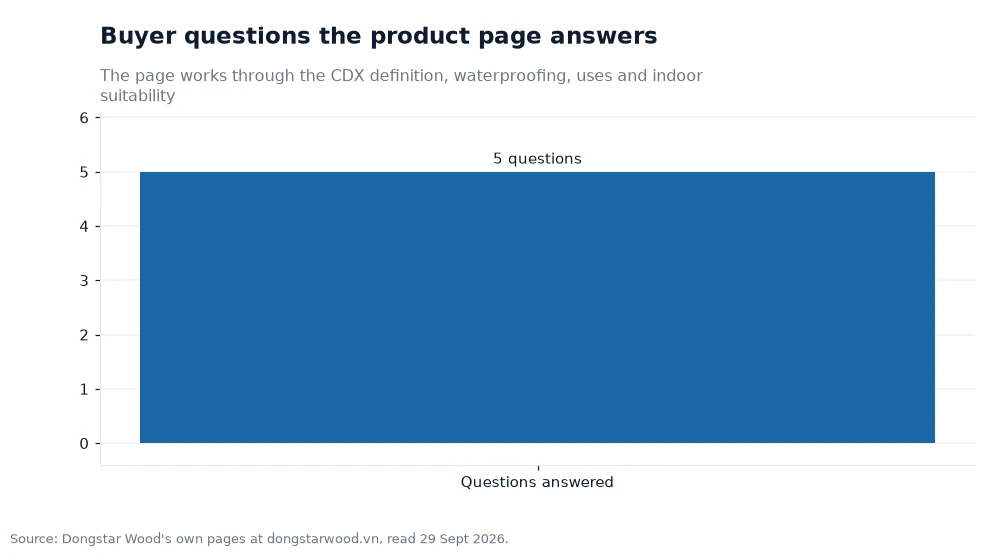
Structural panels also leave the building site entirely. Crating and industrial packaging use the same material for heavy-duty crates and pallets, where the stiffness that matters is against impact rather than moisture, and construction barriers or temporary structures use it for hoarding, fencing and temporary floors.
Thickness is a separate part of the specification and usually settled by the span. A subfloor across joists at close centres can use a different thickness from a roof deck carrying tiles, and both are covered by the same face and glue description, so the enquiry should name the position as well as the panel type.
Moisture during installation is worth planning rather than reacting to. Where a deck is laid and covered within the same week, the exterior glue line is simply insurance; where the frame will stand open through a wet month, the covering sequence belongs in the programme before the first sheet goes down.
Both uses favour the economical face grades. Nobody inspects the surface of a pallet base or an internal hoarding panel, and buying a higher face grade for those positions is paying for an appearance that will never be seen.
Worked example: sheet coverage for a roof deck
Ordering in batches also changes the arithmetic. A deck built in two stages of 45 m² each needs the same total coverage, but the first delivery can be checked for flatness and fixing quality before the second is released, which is a sensible way to place a first order with a new supplier.
Coverage arithmetic is simple once the sheet area is fixed. At 1220 × 2440 mm, one board is 1.22 × 2.44 m gives 2.98 m² of deck area.
A single-storey roof of 90 m² therefore needs 90 ÷ 2.98 = 30.2, so 31 sheets (example). Add the usual allowance for cuts, hips and a small repair stock and the order becomes 34 sheets (example). At the same time, the 90 m² figure tells you the underlayment order: the same 90 m² of shingle or tile underlayment follows the deck dimensions, not the sheet count.
Frequently asked questions
Can CDX be left exposed to weather?
It is designed for construction-phase exposure, not long-term exposure. The exterior glue resists moisture and rain while the building is open, and the panel performs best when it is covered reasonably soon after installation rather than left to the weather.
Is a D-grade back a structural weakness?
No. The grade describes appearance and repair level, not strength. The structural performance comes from the pine veneers and the cross-laminated construction, so a rougher back face does not reduce the panel's ability to carry a floor or brace a wall.
Which positions take a CDX panel indoors?
Subfloors, wall bracing and structural frames. In those positions the exterior glue line is tolerance against a wet build stage rather than weather protection, and it lets a floor be laid before the building is fully closed.
Checking the rest of the mill's range
Anyone buying structural panels usually buys other categories alongside them. The company profile sets out the factory area and certificate list behind the range, and the formwork-side of the catalogue covers the panels used once the concrete frame goes up.
Grade definitions and applications are from the manufacturer's own website, verified on 29 Sept 2026 as referenced in the table above as referenced in the table above as applied to this article[1].